
Severity of Decline and its Causes
Many consider bluefin the greatest of big game fish.
However, it's also in the greatest danger of extinction
because of the price on its head.
Here are the facts.

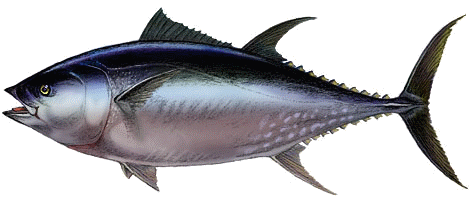
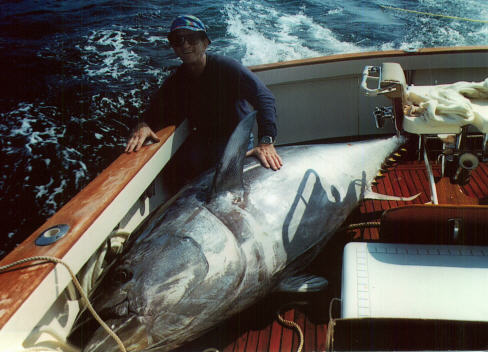
"It's like hooking up to a car doing 50 miles an hour.� Marlin and sailfish are spectacular.� But they wear themselves out with all their jumps.� Giant bluefin have more power and stamina than anything else."
Jack Cashman

a Giant Bluefin Tuna
It's described by Jim Chambers in his feature article entitled "Hunting Giants".� It appears in the August 2000 issue of Sport Fishing Magazine, shown at right.� That's Chambers (left) and the crew of the Tuna Hunter on the magazine's cover straining to bring a 900-pound giant aboard.
�
To read the full article, CLICK HERE.
But, this Premiere Gamefish
is in Deep Trouble
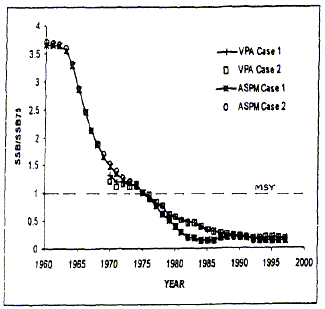
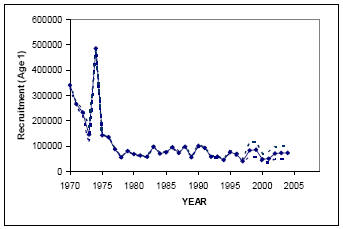
Above - abundance of spawning size bluefin (620 lbs. and larger) was last at the long-term sustainable population level (MSY) in the mid-1970s. It has declined much more dangerously since. Conveniently, ICCAT policymakers recently "redefined" MSY at half the level shown above - a clever, but bogus way to avoid having to reduce catches as needed to rebuild the stock.� This was described as "moving the goalposts to the 50 yard line." Incredibly, the U.S. government's representatives to ICCAT agreed to this bogus approach -� but without even consulting their own scientists on its validity.�
Below - using the "new" definition, the 2006 stock assessment estimated that by
the end of 2004, the population of western-spawned adult bluefin -"our"
bluefin - had been driven to 18% of its new MSY level.
Regardless of how MSY is defined, the fact is that compared to its abundance
before longlines were introduced (i.e., 1960), the population
is now just 3% of its former level - a 97% decline. Recent research
has found, however, that perhaps half of the bluefin we thought were "ours"
are really bluefin spawned in the Mediterranean which had migrated for
feeding off the U.S. coast. So, we really may have left only 1.5% of
the western stock of bluefin that existed in 1960 when the population began
its steep decline caused by overfishing. Ominously, it is
still slowly declining toward extinction, as can be seen below.
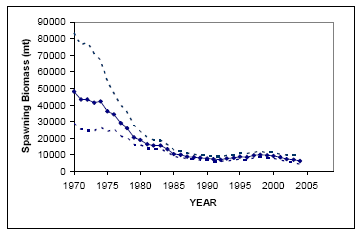
Nearing Extinction - The species in the greatest danger of slipping into extinction is the
western North Atlantic population (stock) of bluefin tuna.�
Thanks to 4 decades of overfishing, it has been driven to just 3% of its 1960 or pre-longlining abundance - a decline of 97%
- as shown in the figure at left. �(ICCAT
is the international commission that claims management authority over all
tunas, marlin, swordfish and the other big fish of the Atlantic.) The
bulk of the decline which occurred prior to 1975 was caused by Japanese
longline fishing on the adults as they concentrated annually for spawning in
the north central Gulf of Mexico. In
comparison to bluefin, by 1998 Atlantic white marlin abundance had been driven to 6%
of its pre-longlining abundance, and Atlantic blue marlin had been driven to
20% of its pre-longlining abundance. Both have continued to decline
since (for the details see Marlin).
For more than two decades, ICCAT considered the
spawning stock biomass which existed in the mid-1970s to be the maximum sustainable yield (MSY) level for
"our" bluefin tuna - i.e., the western North Atlantic bluefin tuna stock.� The MSY level is represented
in the figure at left by the dashed line at 1.0.� Responsible fishery managers
would never allow the population to decline below the MSY level which is ICCAT's stated management goal. Yet, since 1975, the population has been allowed to decline by an additional 88% percent
and it has been hovering at12% of its 1975 level.� Thus, in just four decades, the population was driven from a healthy level (over 3 times the MSY level) to
3% - a level just above extinction.� This occurred due to years of
overfishing sanctioned by ICCAT on this, the world's most valuable fish.� (A single bluefin sold for $172,400 at the first auction of 2001 at Tokyo's Tsukiji Fish Market.)� The population is being held at this precarious level by continued overfishing allowed by ICCAT, ostensibly to provide scientific monitoring information on its status.� In reality, it is unnecessary to kill any remaining bluefin until they can recover since the abundance of each year class could be assessed using aircraft and other non-lethal means (tagging). But this would eliminate the large profits continuing to be made by a few
dealers with political influence...� Clearly, key members of the U.S. Congress and responsible NMFS officials have been more than willing to "sell-out" the resource for a very long time.� In my view, it's nearly too late.� Make up your own mind.� I think we should call a "time-out" - no more lethal fishing on this stock - for 5 years.� Otherwise, we may lose them entirely.� They are simply too magnificent to be pushed into extinction for the short-term profits of a few
exporters.
Lawsuit Filed to Protect Spawning Areas - On November 1, 2006, Earthjustice filed a lawsuit challenging the failure of NMFS to limit longline fishing (through the use of closures) in the Gulf of Mexico during their spawning season which is contributing to the decimation of adult bluefin tuna. Press release available here.
Endangered Species Act Protection Sought - Because of the dire situation described at left, in May 2010, the Center for Biological Diversity filed a formal petition with the Secretary of Commerce to have North Atlantic Bluefin Tuna declared a "threatened" or an "endangered" species and protected under the U.S. Endangered Species Act. Click here for the CBD Press Release and here for the petition.
The Deepwater Horizon disaster could not have come at a worse time for bluefin survival. The western North Atlantic bluefin population - "our" bluefin - spawn each year in the north-central Gulf of Mexico during May - this year beginning just after the blowout started. Its eggs and larvae were carried by the "Loop Current" directly into the oil. Any eggs or larvae coming in contact with oil will die. The oils' effects on young bluefin have been magnified by the use of dispersants which are also toxic and which dissolve the toxic oil and can spread it top to bottom throughout the water column.
One North Atlantic Stock or Two? - According to the world's scientific community (as represented by ICCAT's scientific advisory committee), the western and eastern North Atlantic bluefin tuna stocks are two separate and distinct populations that do not interbreed.� Their spawning areas are thousands of miles apart (see Bluefin Spawning Areas).� The western stock spawns in the north-central Gulf of Mexico, from May 1 through June 7, and ranges during the summer through fall along the east coast of North America as far north as Labrador and out into the North Atlantic following the Gulf Stream.� And the lack of prey (herring, whiting, menhaden, etc.) due to overfishing in nearshore shelf waters off New England has likely driven them increasingly north off Nova Scotia or farther offshore toward the mid-Atlantic. The eastern stock spawns in the Mediterranean Sea, primarily in June, and ranges during the summer through fall in the Atlantic from the Canary Islands to south of Iceland.� There are also great differences in the size at which the two stocks mature.� The western stock reaches maturity on average at about 620 lbs. (12 years old) - roughly six times the size at which the eastern stock matures (i.e., between 85 and 135 lbs. and 4 to 5 years of age).� There is substantial intermixing of the adults of the two stocks during the summer-fall feeding period particularly along the Gulf Stream in the central North Atlantic and to a lesser extent off the U.S. east coast. However, by late spring the adults of the two stocks return to their respective spawning areas, just as do salmon.� Recent archival and pop-off tagging programs are now available that clarify these large-scale migrations, spawning site fidelity of the two stocks, size of maturity and even daily feeding movements to depths of a half mile for an hour or more.� Recent scientific findings are reported in Nature, Vol. 434, p. 1121, April 28, 2005.
Severity of Atlantic Population Declines
Overview
Swordfish
Blue Marlin
White Marlin
Bigeye Tuna
Sailfish
Large Sharks
Daily "Kill-o-Meter"
Endangered Species Act
Bluefin Tuna
"Listing" Petition
White Marlin
"Listing" Petition
Spawning Areas
Bluefin Tuna
Chambers and Associates
Overview
List of All Pages on this Website
Home
World Records and Other Large Game Fish
Photos
Index
Giant Bluefin Tuna - pg. 1
Giant Bluefin Tuna - pg. 2
Pulled Overboard
All Tackle World Record Bluefin
Swordfish -
3 pages
Atlantic Blue Marlin -
4 pages
Pacific Blue Marlin - 3 pages
Black Marlin - 2 pages
Bigeye Tuna
Yellowfin Tuna
White Marlin
- 2 pages
Sailfish
Spearfish
Large Sharks
Articles on Big Game Fish and Fishing
Overview
Hunting Giants
Hunting Grander Blue Marlin and Bluefin
Those Magnificent Giants
Going, Going, Gone
Headed for Extinction
9814 Kensington Parkway
Kensington, Maryland 20895
(T) (301) 949-7778 � (Fax) (301) 949-3003